
Because many of my posts about early days in the Perth area of Lanark County, make reference to the Rev. William Bell, I am posting some information about him.
The following post and others to follow are excerpts captured from ‘wordstar’ and ‘wordperfect’ files inherited from My father, J.R. Ernest Miller who, in 1992, published 175 Years of Presbyterian History, First Presbyterian Church and St. Andrew’s Church, Perth. I share these files as the names mentioned may provide clues for others seeking family information in the ‘black hole’ of eastern Ontario history prior to the first census in 1852. The book contains much more. See note at end of post.
When the Settlement of Perth was formed in 1816 a number of the settlers, being desirous of having the Ordinances of the Gospel administered among them, transmitted a petition to the Associate Presbytery of Edinburgh, that a Minister might be sent to them. The Presbytery granted their petition and sent out the Rev. William Bell as their Pastor, with Government approval as appears in the following letter.
Downing Street, 12th April 1817
Sirs:
The Reverand (sic) William Bell will have the honour of delivering this letter to you. He has been selected by the Associate Presbytery of Edinburgh at the request of the Settlers on the Rideau to officiate as their Minister. I am to request you will afford him every protection and support in the exercise of his functions and you will give the necessary directions for issuing to him from the Colonial Funds an allowance of 100 Pounds Sterling per annum, commencing from the 18th ulte., which it is intended should be paid to him by the Public in addition to such provision as may be made for him by the Settlers among whom he may reside.
I have the honour to be, Sir,
Your most obedient humble servant,
Lt. Governor Gore
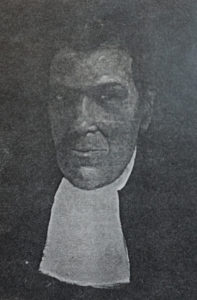
Rev. William Bell arrived in Perth on the 24th of June 1817 and on the following Sabbath commenced his public labours. There being no regularly organized congregation, he consulted some of the people as to what ought first to be done and it was agreed that a general meeting should be called on Wednesday the 9th of July 1817 for the election of managers and a person to conduct the singing.
Perth, 9th of July 1817
The Congregation met and being constituted with prayer by the Minister, the following persons were chosen a Committee of Managers; Dr. Alexander Thom, Captain Josiah Taylor, Messrs Francis Allan, William Adams, Peter McPherson, John McLeod, James McLaren, John Adamson, John Ferguson, Francis Willocks, James Bryce, Alexander Kidd, Samuel Purdie, Alexander McFarlane, Angus Cameron, and William Morris, Treasurer, John Holliday, Clerk, and Rev. William Bell, President. After some discussion about the choice of Precenter, it was agreed to defer it till some future meeting. The meeting then dissolved after appointing the Committee to meet on the 16th instant to consult what was best to be done about providing a house for the Minister.
Rev. William Bell and St. Andrew’s Church
Immediately after arriving in Perth, Rev. William Bell, upon finding temporary accommodation for his family, set out to visit the Scotchline settlers and arrange for the first church service on the following Sabbath, July 29th 1817. This was held in a large room over the Red Inn on Craig Street, owned by John Adamson. The room was unfinished and unfurnished and was reached by a ladder.
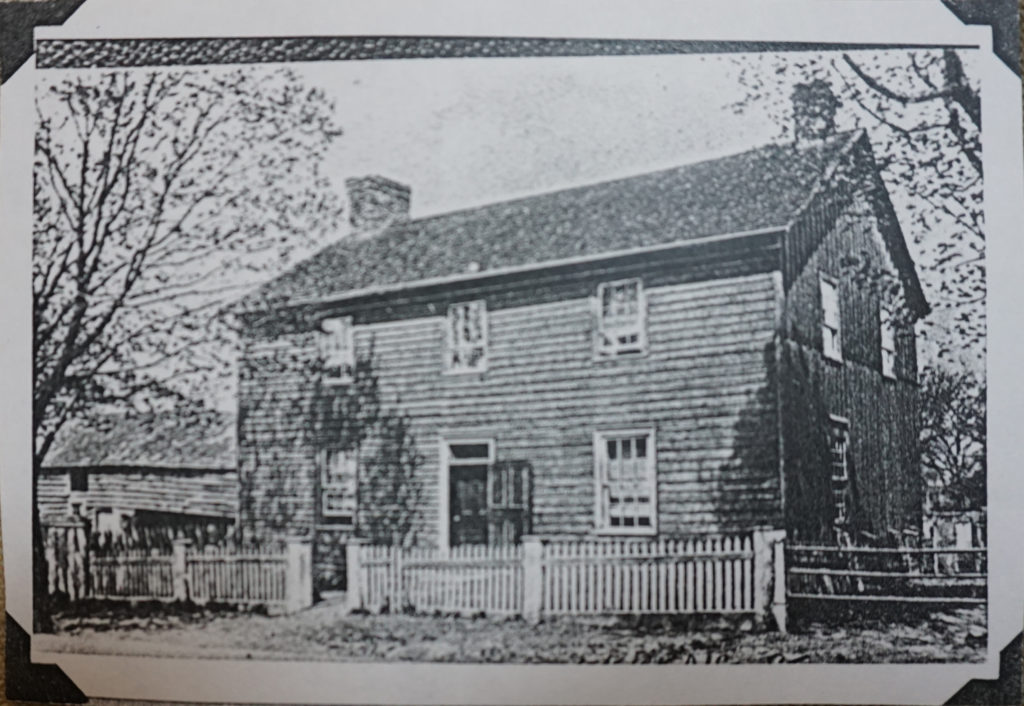
About thirty persons were present including Government people, militia officers and a few Scottish settlers. The Rev. William Bell preached to them at eleven and again at two o’clock.
In June of 1817, of the nineteen hundred persons in the settlement, some twelve hundred were soldiers and their families and only seven hundred were Scottish settlers, over half of whom were children.
On September 14th 1817, the Lord’s Supper was administered for the first time in Perth, with forty communicants admitted, two of them for the first time. It was agreed that this Ordinance should be administered every three months. It was accordingly administered on the second Sabbath in December with two new members admitted. It was now considered advisable to proceed with the election of Elders.
On January 4th 1818 at a general meeting of the members of the Church, with Rev. William Bell as Moderator and two neutral persons, namely John Adamson and John Jackson as witnesses of proceedings, the following persons were unanimously elected as Elders of the First Presbyterian Church in Perth; John Campbell, James Bryce, Thomas Cuddie, John Ferguson, Angus Cameron, William Rutherford, Peter McPherson, Duncan Robertson and Robert Smith.
Upon being examined and found that they professed a competent knowledge of the Doctrines taught in the Word of God, John Campbell, John Ferguson, Angus Cameron, Peter McPherson and William Rutherford were Ordained Elders on February 1st 1818; the others having failed to appear at the appointed time.
LIST of ELDERS ORDAINED by Rev. William Bell 1818‑1857
| NAME | ADDRESS | ORDAINED | LAST NOTED |
| John Campbell | Bathurst | 1 Feb 1818 | died 20 Oct 1818 |
| John Ferguson | Bathurst | 1 Feb 1818 | 31 Aug 1826 |
| Angus Cameron | Bathurst | 1 Feb 1818 | 12 May 1822 |
| Peter McPherson | Elmsley | 1 Feb 1818 | died 1844 |
| William Rutherford | Perth | 1 Feb 1818 | before 1838 |
| Peter Campbell | Drummond | 21 Jan 1821 | died 5 Jan 1848 |
| Duncan McTavish | Drummond | 21 Jan 1821 | before 1838 |
| James Ward | Bathurst | 21 Jan 1821 | 4 Dec 1825 |
| James Bryce | Bathurst | 21 Mar 1821 | 1838 |
| William Elliott | Bathurst | 28 May 1826 | 1838 |
| Benjamin Carr | Bathurst | 4 Jun 1826 | 10 Sep 1836 |
| John Holliday | Burgess | 3 Sep 1826 | before 1828 |
| Robert Davidson | Perth | 17 Jun 1832 | 1844 |
| Thomas Nicoll | Perth | 3 Mar 1833 | Resigned 1836 |
| George Cuthbertson | Perth | 9 Mar 1835 | Died 1838 |
| John Ferguson | Drummond | 25 Nov 1838 | 25 Nov 1854 |
| Daniel McDonnell | Perth | 25 Nov 1828 | Jun 1847 |
| Ralph Smith | Bathurst | 25 Nov 1838 | 1844 |
| Duncan Morrison | Perth | 15 Aug 1847 | 9 Sep 1848 |
| Patrick Campbell | Bathurst | 23 Feb 1851 | 1853 |
| John G. Malloch | Perth | 23 Feb 1851 | 1857 |
| Alexander Fraser | Bathurst | 23 Feb 1851 | 1857 |
About the Book 175 Years of Presbyterian History
In the ‘forward’ to the book, Ernest Miller notes:
“In attempting to record the story of the struggle of our Scottish ancestors to establish the Church of their choice in their new home, I cannot help but realize how desperately they needed the Church as an anchor to hold on to and to stabilize their lives as they struggled to establish themselves in this new country, Upper Canada.
I have made no attempt to glorify the role of the Church, but I have instead attempted to set out a factual record of the role the people played in establishing and maintaining a place of Worship in Perth and area.
I have used Session Records, Copies of letters recorded in Church Registries and Congregational meetings as a source of material in my attempt to record the History of Presbyterian Worship in Perth and the surrounding Townships. I hope it may be of some value as a record of 175 years of struggle to establish and maintain the Faith of our Fathers.
In the early days, there was no civil court in the Perth district and the Church assumed the role of monitoring not only the moral conduct of the members but also acted as judge and jury on civil matters under dispute.
Rev. William Bell and his Session ruled with an unbending attitude on matters brought to their attention. Some settlers, hoping for a more lenient judgement than that meted out by Rev. William Bell, sent a request to Scotland for a Minister of the Church of Scotland. Records indicate that Rev. Thomas Clarke Wilson and Rev. William Bain were just as harsh in their judgement. Many pages of Session records describe in detail the offences and the penalties meted out to accused members.
The Sessions were particularly concerned with the moral conduct of the members. Illegitimate births, premarital fornication, drunkenness, obscene language, breach of promise, breaking the Sabbath by doing unnecessary work such as gardening or gathering sap, were considered reasons for being cited to appear before Session and be refused access to the Lord’s Table for several months. Many cases required several appearances before Session, with an endless stream of witnesses for both the accused and accuser.
Those persons whose offences were being considered by Session were refused admittance at the Lord’s Table until such time as their case was resolved and they were judged to be repentant for their omissions. In those early days a member was admitted to the Communion Table only by presenting a token which was given to those attending Preparatory Service the previous evening.

 Family History Musings